ROSARY
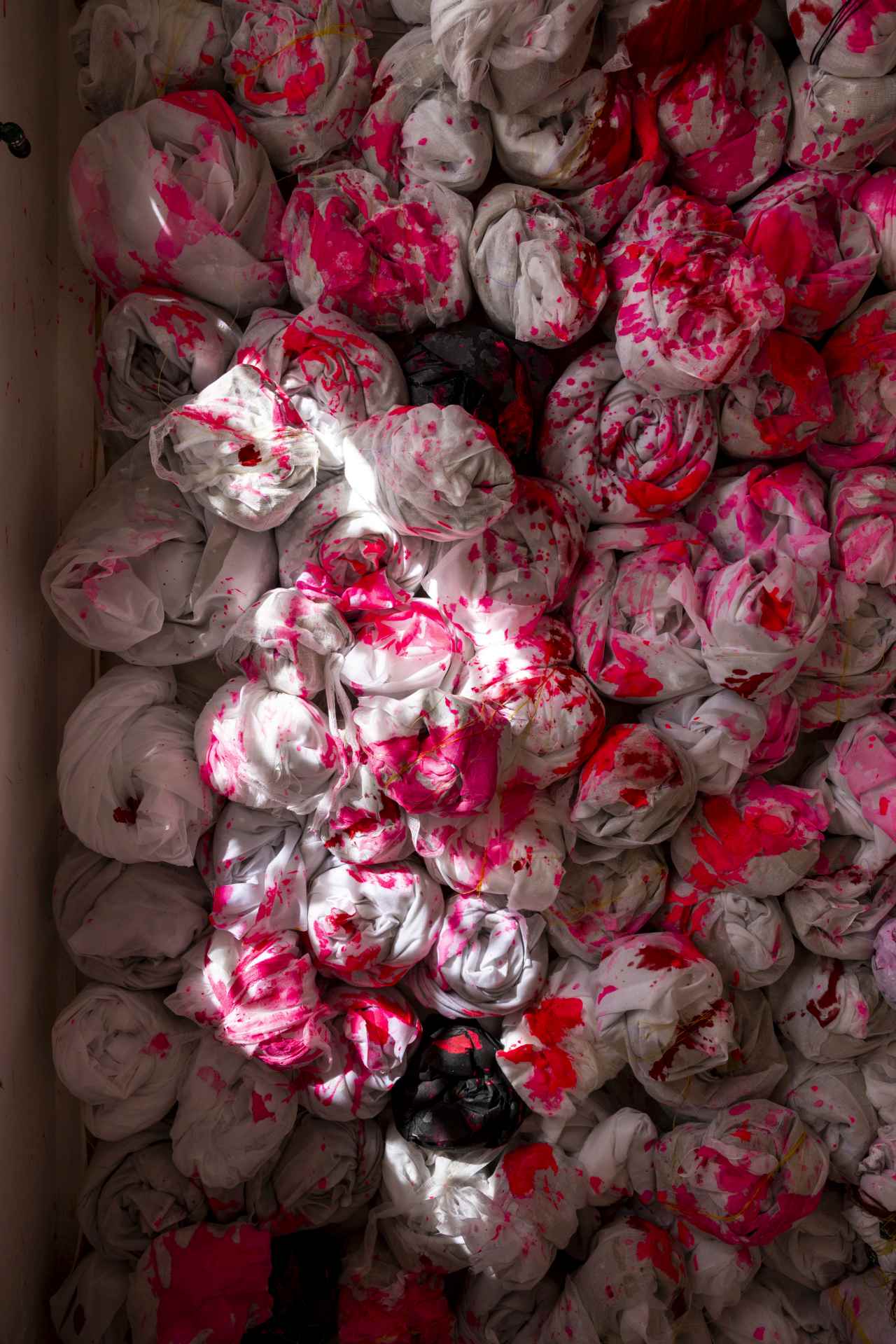
It was in the late 1980s that Dubravka Lošić began the Rosary cycle, which would eventually become the longest-running and the most publicly recognisable segment of her oeuvre. Rosary begins as a radical transgression of the boundary separating painting from object. Collage and assemblage are no longer interventions on the surface but its very constitutive principle. In this transition, the rose emerges as the fundamental morpheme of the cycle, not as an iconographic quotation, but as a modelled, haptic form that repeats, proliferates, and structures the surface into a tangible relief presence. The painting sheds its illusionistic neutrality and becomes a physically articulated field: compressed, charged, and materially alive.
This shift is inseparable from the broader context of Croatian art in the 1980s, and in particular from the experience of New Image Painting, which reaffirmed the picture as a space of subjective gesture, heightened materiality, and formal freedom. In her hands, this framework does not express itself as a return to painting in the classical sense, but as an opening of painting outwards, towards relief, object, and tactile construction. Hence pigment and colour in the Rosaries operate neither descriptively nor decoratively, but aggressively and structurally: the coiled roses traverse a range from saturated red to an almost fluorescent pink, compounding the impression of an incandescent, artificial, and affectively overwrought surface.
The first spatial culmination occurs in 1988 with the installation Rosary in the Church of Our Lady of the Rosary in Dubrovnik, where a substantial rose object, constructed from cardboard and adhesive, is suspended between Renaissance columns, introducing relief into a sacred setting without recourse to literal iconography. At this juncture, the rose definitively ceases to operate as a motif and instead assumes a structural role, from which the internal logic of the cycle proceeds to unfold. The rosaries emerge as relief fields in which meaning remains unstable, shifting between colour, rhythm, and tactility. The surface is either saturated from edge to edge or the relief withdraws towards the frame, opening space for collage interventions. In both configurations, a dynamic interplay is established between covering and uncovering, accumulation and stratification, and the cycle develops as a system of accumulation, without final resolution.
Between 1987 and 1993, particularly in the years just before and during the wartime destruction of Dubrovnik, the works increased in scale and their colouristic tension grew more pronounced. The post-minimalist discipline of repetition gave way to a rich, saturated density. Diptychs and polyptychs can be seen as echoing the structure of altarpieces, though without a fixed sacred function. From the mid-1990s onwards, the cycle continued to evolve through variations, ranging from smaller formats to chromatically intense relief compositions, showing that the rose remains an open form, capable of receiving new layers of meaning. Each new Rosary builds upon its predecessors without bringing the system to a close.
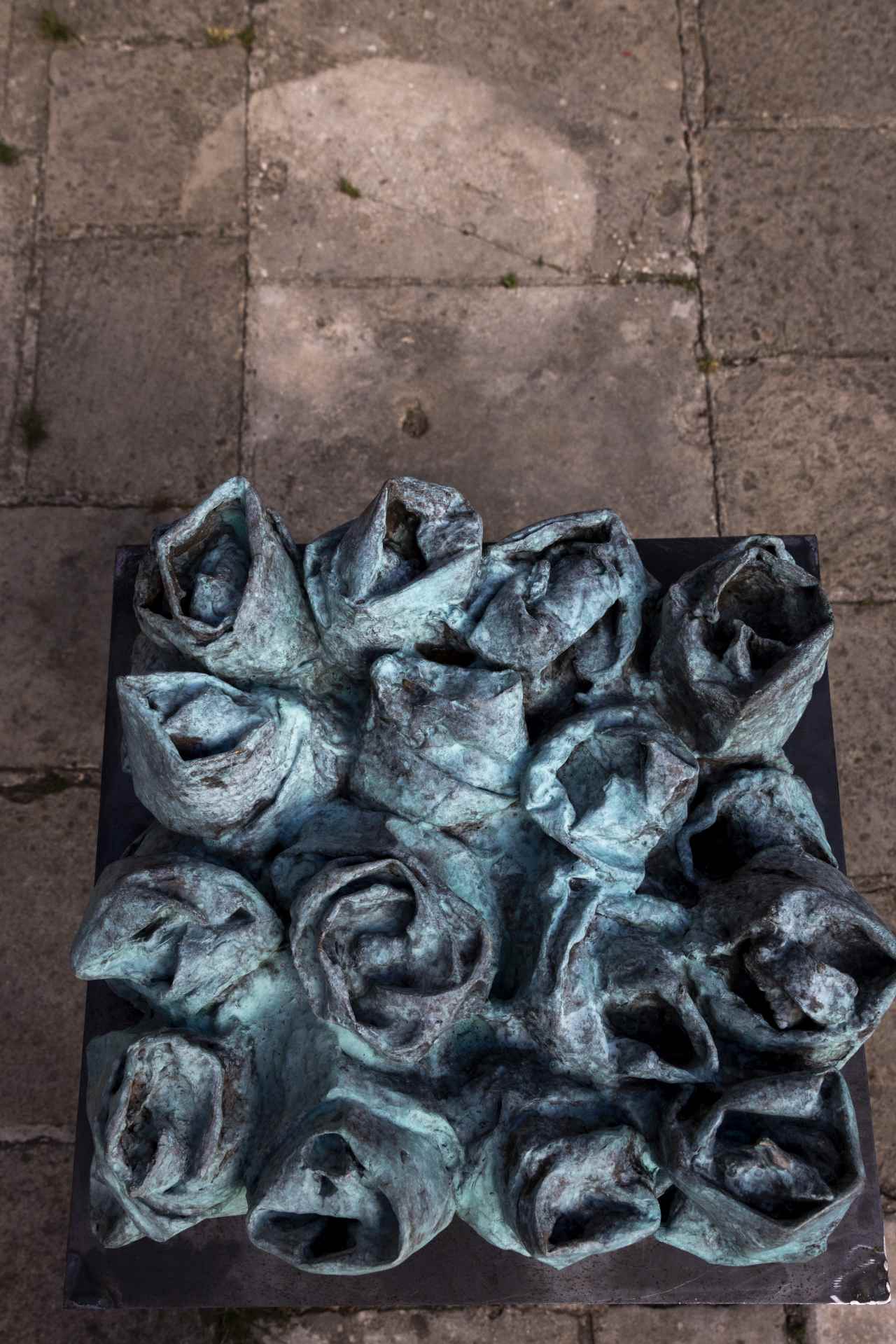
In the Venetian presentation, the rosary appears in two registers: in the courtyard of Palazzo Zorzi as a newly produced sculptural group executed in bronze, and on the piano nobile as a series of expressive relief compositions woven into the broader orchestration of cycles on display in the Codussi Hall. Entering into dialogue with the Libertas Bells series, whose monumental bell-shaped forms and metal supports establish the vertical and constructive axis of the courtyard installation, the rosaries preserve the relief compactness and surface density. Set against the rigid metallic structure of the bells, the textile and relief rosaries give form to a tension between soft and hard, interior and public, intimacy and representation.
The Rosary remains a cycle in which Dubravka Lošić’s longstanding preoccupation with the transformation of painting, the discipline of repetition, and the material tenacity of form is most clearly manifested. Over the course of nearly four decades, it has evolved as an open system in which meaning is generated through the interplay of material, rhythm, and structure, rather than from any fixed symbolic meaning.
Marta Radman