LIBERTAS BELLS
;
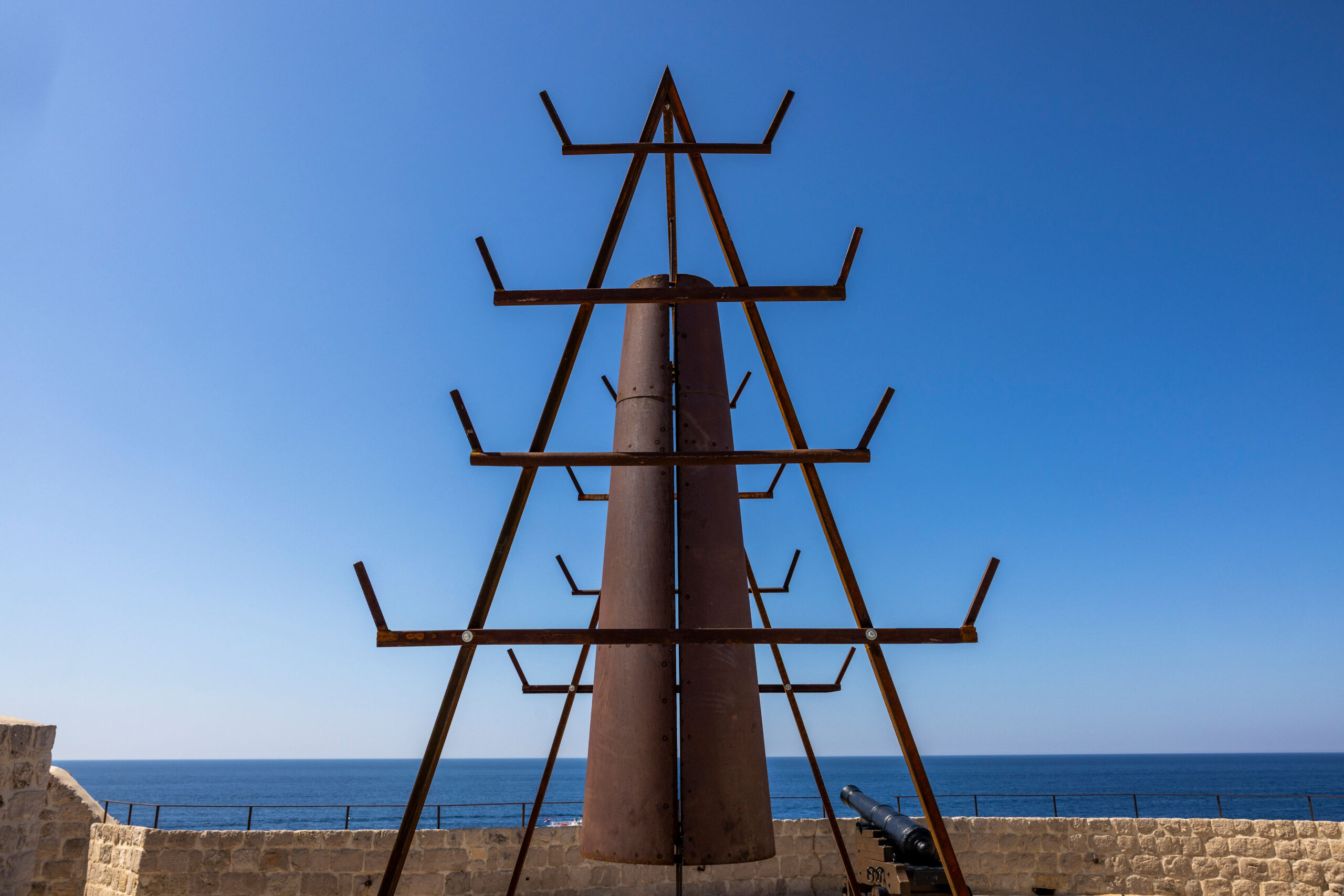
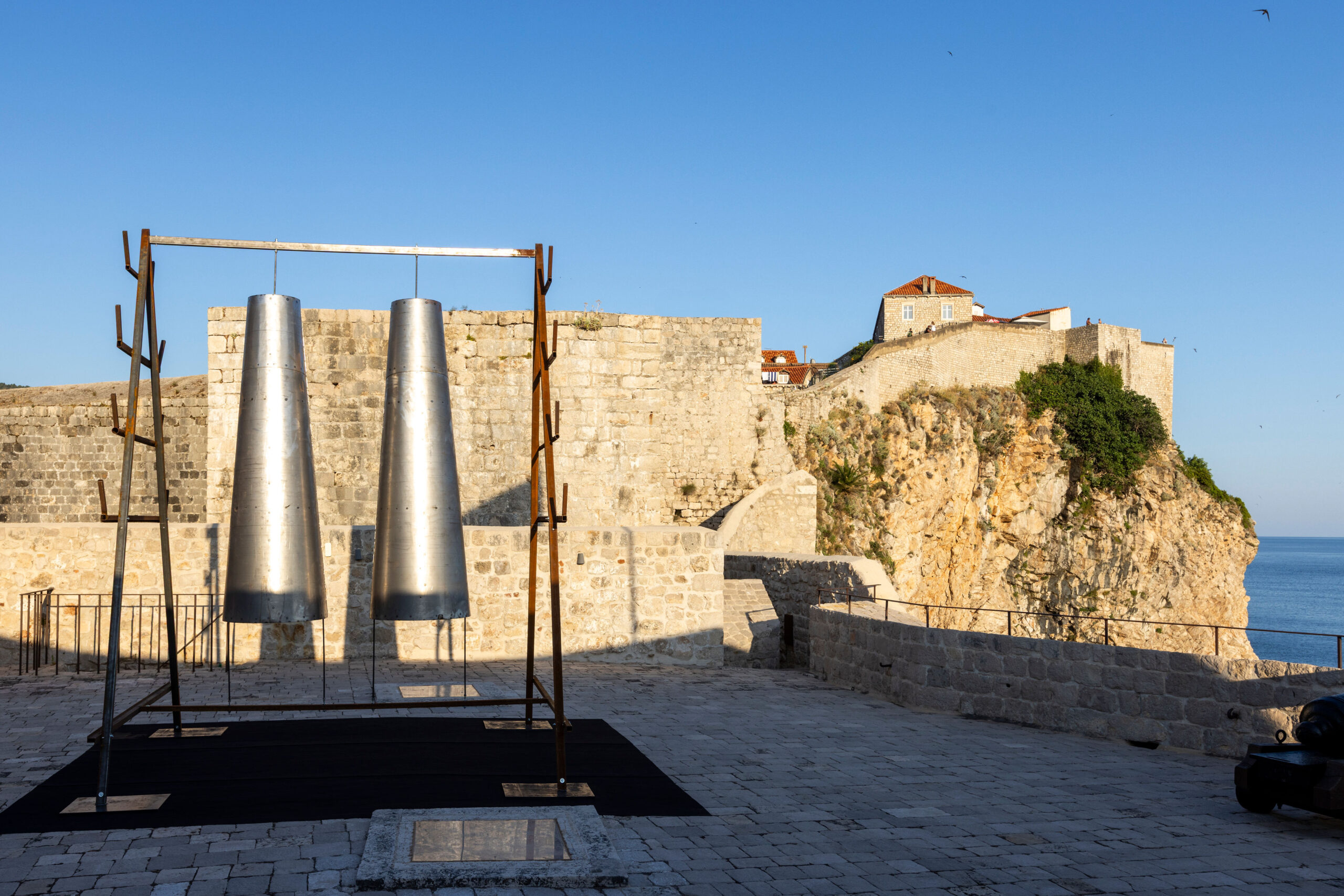
The Libertas Bells series, developed since 2014, stands as one of the most concentrated and monumental expressions of Dubravka’s enduring preoccupation with form as a repository of historical, personal, and material charge. Whereas in the cycle Rosary, energy is condensed into a relief surface, in the saturation of textile and the repetition of sign, here that same tension is released into volume and verticality. What was there compressed and incandescent at the surface now stands erect, collected and weighty. Beginning from the archetypal form of the bell, the artist distils the shape into a purified volume, a mass that holds itself in taut relation to space and gravity. The bell is not deployed as an illustrative symbol; it does not invoke history through rhetoric, yet carries it within its very material.
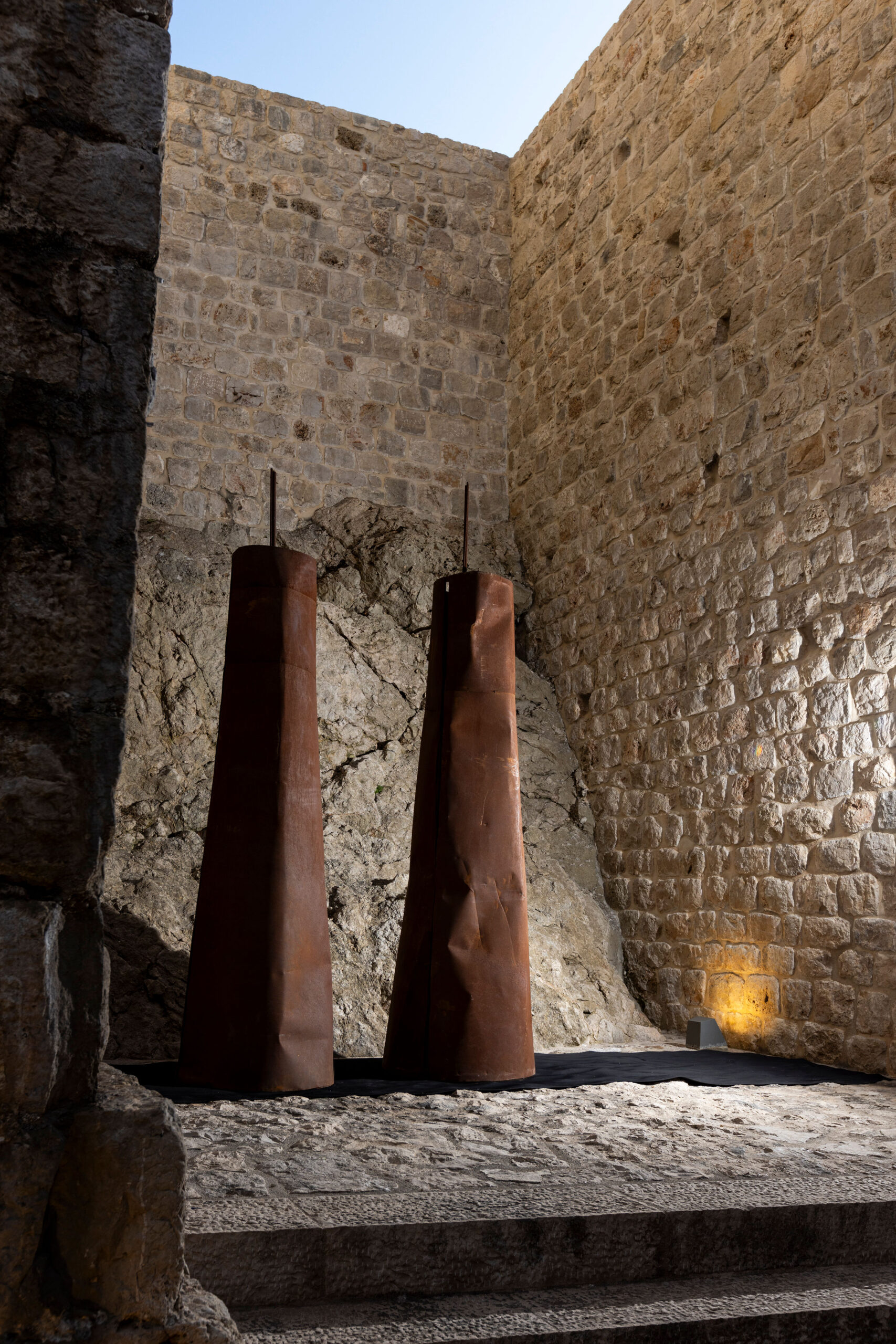
The work finds its origin in the 2014 sculpture Bell, two black steel cones installed in the public space of Dubrovnik. When they were unlawfully removed and returned damaged, the artist resolved not to reinstate them in their original, “correct” form. Rather than restore, she made a new and more monumental pair, over four metres in height, conceived as an extension of the earlier work and a conscious homage to it. In the Venice presentation, old and new bells appear together: those from 2014, bearing the imprints of time and experience, alongside those completed in 2025, which are only now embarking on their own life in time. What distinguishes them is not form but condition. It is this very simultaneity, of the damaged and the untouched, the past and the present, that gives the cycle its full gravity.
In the context of Dubrovnik, where the notion of libertas is deeply inscribed in the city’s urban and cultural identity, a bell is never a neutral object. Yet liberty here has never been unambiguous or unconditional: historically affirmed as a supreme value, it has at every turn been defined by the constraints of power, political reality, and the exigencies of survival. A similar ambivalence lies at the core of Dubravka Lošić’s work, in which freedom emerges not as an unrestrained gesture but as a choice that always bears the weight of conditionality, responsibility, and risk. It is for this reason that it is presented here neither as historical reminiscence nor as a declarative sign, but tested within the material itself, in the heft of metal and in its exposure to time. The metal surface reacts to sun, salt, and humidity; change is not an incident but a permanent condition. The bells are silent, yet that silence is not emptiness. It is sound held in a state of potential.
In the courtyard of the Palazzo Zorzi, Libertas Bells enters into a dynamic dialogue with the bronze group of Rosary and the Tondo cycle, generating the opening spatial and semantic tension of the installation as a whole. The pairs of bell-like forms, together with their metal supports, establish a vertical axis through the courtyard, whilst the bronze rosaries and the painted wood-and-textile objects of the Tondo cycle introduce a contrasting rhythm of volume, surface, and material saturation. In this interplay, what in other cycles erupted through colour, texture, and repetition is here distilled into an almost ascetic formal language. That restraint does not lessen the intensity; it concentrates it.
Within Dubravka Lošić’s body of work, Libertas Bells constitutes a radical act of simplification, though not a reduction of meaning. Personal experience, local history, and material duration are not separated in this work but refracted through a form that bears simultaneously the imprint of damage and the possibility of renewal. Freedom emerges here not as a fixed value, but as a condition that sustains and affirms itself through the passage of time.
Marta Radman